Monday, March 17, 2014

Our 2014 Diversion to Coyote Canyon, in the Anza Borrego Desert

Last year around this time, Gary and I made a little trip to Coyote Canyon in the Anza Borrego State Park. We were so intrigued by the riparian area in the middle of the arid desert that we decided to return this last weekend, this time with several friends.

This year was drier even than last (which is saying something, as last year was pretty parched). But Coyote Creek was running steadily, if not very high, and some flowering trees, shrubs and forbs were to be found. Beetles were here and there, but not numerous. The majority were tenebrionids found on the ground after dark. The stars of the show were the tree frogs, of two species (the California Tree Frog, Pseudacris cadaverina and the Pacific Tree Frog, Pseudacris regilla). The California Tree Frogs seemed by far to be the most numerous. They were calling day and night, in hopes of making more frogs, and any stroll near the creek would reveal little hoppers here...there...everywhere.

This will surely be a spectacular spot to visit in a wet spring!

The weekend before, we made a short day trip to the area to check out access to Sheep Canyon, further up from where we camped in Lower Coyote Canyon. The steep part of the access road had been "cleaned up" by the State Park, and we were actually able to creep up it slowly in 4WD low. This would have been impossible the spring before, as it truly was "Boulder Alley" then, and only the most capable four-wheel-drive vehicles could make it.

This weekend we only hiked to the lower lush "forest" and not all the way to Sheep Canyon. Many endangered Least Bell's Vireo were nesting in the thick willow-dominated woodland.

Sheep Canyon, from our visit on March 9. Native California Fan Palms are visible scattered throughout the rich forest.

Coyote Creek. Many tracks of coyotes (of course), bobcats, raccoons, squirrels and others were near the life-giving water. On Sunday morning VERY early (before dawn) three of us thought we heard a distinct "meow" sound near our camp. After later investigation, it did sound quite a bit like a certain vocalization that bobcats make.

California Tree Frog, Pseudacris cadaverina, the most commonly seen frog species for this trip. All the remaining frog images below are of this species, except the last photo. This one was seen (along with many of his friends) on a night hike Gary and I took on Friday evening.

I couldn't manage to capture an image of a fully inflated throat sac - those frogs were a bit too shy for the camera.

On Saturday, during the day, several of us walked over to the nearby creek from our camp, with chairs, and settled in by the trickling waterway for relaxing time. I never did encounter my fellow humans, but where I settled in there were plenty of frogs, and they slowly emerged from hiding and proceeded to do frog things as I sat quietly nearby. These two croaked and crawled on each other (but never mated) and then hunkered down under this tiny overhang, to escape the heat.

A pretty little frog amongst the fallen blossoms.

A nice classic pose.

I guess there can be no such things as too many frog photos!

I saw very few Pacific Tree Frogs, which is the more common species in Cuyamaca Woods. But this one is unmistakeable, with the dark eye-stripe and less blotchy markings.

Asbolus verrucosus. We saw about a dozen total on the trip, which I thought was quite a lot for the Anza Borrego Desert.

Acmaeodera sp. on Apricot Mallow. Still waiting to identify to species.

Edrotes ventricosus, a small fuzzy darkling beetle. We saw several on our evening hike.

What appears to be Sphenophorus sp., a billbug (a type of weevil). It was on the sandy road just adjacent to the rich riparian area.

Cerenopus concolor, a darkling beetle.

Pupa of...? This was right next to the creek, and when I knelt down nearby to photograph a track in the mud, it started wiggling and whipping back and forth!

I tried to take a short video of the wiggling pupa, but operator error prevented my getting a movie (just this still image)! In other words, I forgot how to do THAT on this camera! This image still sort of conveys the action, though.

Raccoon tracks in the mud. Last August and September there were massive monsoonal floods that ripped through the canyon, and I think some of these tracks may date back to that time (we've had virtually no rain in the local desert since).

The Guys, posing with a huge metal THING we found sitting in the middle of the desert! This THING isn't going anywhere soon, I suspect. It was impressive, though.

Wednesday, January 8, 2014

A Diversion to the Salton Sea: Our Annual Visit

Usually, Gary and I take a trip out to the Salton Sea sometime when the year is still new and fresh. The air is not exactly fresh at the Sea, but the birds are pretty wonderful. This year was no exception.

Snow Geese in flight, Vendel Road. There were some Ross' Geese here and there in amongst the bigger Snows.

We only saw one Burrowing Owl this year, this one along Lack Road. Interesting to see its burrow (at lower right).

We encountered this scene along Vendel Road. This was the Wildlife Refuge, and clearly marked, so it's unfortunate that there was a need to post a sign saying "Don't gas the owls"!

I loved this assemblage of Cattle Egrets at Unit One. They definitely like to maintain a certain spacing between themselves! Many Snow Geese in the background.

Sandhill Cranes flying over Vendel Road.

Sandhill Cranes in a field along Vendel Road at last light. A tiny flock of the ubiquitous Snow Geese in the background.

A mass of clouds moved in during the afternoon, creating some moody lighting on these Snow Geese along Vendel Road.

Definitely one of the "usual suspects" anywhere in SoCal at this time of year - a White-crowned Sparrow.

This was one of many White-faced Ibis seen. In the non-breeding season, they lose the whitish facial markings near the base of the bill. This was shot with my Canon Rebel THROUGH the old spotting scope, handheld, as an impromptu experiment. Then  I Photoshopped the heck out it to get the painterly feel!

Sunday, December 1, 2013

Mushroom Season

I have been writing articles for the Cuyamaca Woods POA Newsletter for several years now, and thought I'd publish some of them here, so they can have a wider audience. This one was the latest article - appropriate for the season.

Mushroom Season in Cuyamaca Woods

Now that we've had our first significant rain of the season, there might be some interesting fungi popping up here and there in the Woods.

Even though our precipitation later in the season will often be in the form of snow, when the snow melts after the storms move on, the moisture often translates into mushroom and other fungal fruiting bodies in the landscape.

I have been interested in mushrooms and fungi for many years, not because I have any interest in consuming them, but because they make fascinating photographic subjects. And they don't move, or try to run away -- always a plus when it comes to nature photography! And by the way, even if you do enjoy a little chopped mushroom in your salad or accompanying certain main dishes, it is highly advised that you do not collect wild local mushrooms for this purpose, unless you have a deep understanding of the classification and properties of wild mushrooms. As the saying goes: "There are old mushroom hunters, and there are bold mushroom hunters -- but there are no old, bold mushroom hunters!"

A little background biology might help explain the strange, ephemeral nature of mushrooms. When you see a mushroom on a log or popping out of the ground, it is just a temporary reproductive structure (or "fruiting body"), created by the more permanent mycelium of the fungus. A mycelium is a mass of string-like strands of cells (hyphae) which feed by releasing digestive enzymes into the surroundings and then absorbing the nutrients formed by the digestion. When it gets wet, this is a good time for the stationary mycelium to create a structure that can release mobile spores into the surroundings. The spores may blow away, and if they land in a favorable (usually damp) spot, grow into a new mycelium (and a new individual). That is why mushrooms only last a few days, and then seem to melt into a gooey mess when spore production is done.

One of the more spectacular local fungi is the Western Giant Puffball (Calvatia booniana), which appears almost every year on my property. It can reach a diameter of 8 -10 inches and reputedly is good to eat when young and tender (but I don't recommend it!).

Western Giant Puffball, Calvatia booniana

Another large, eye-catching local fungus is the Jack-O-Lantern (Omphalotus olivascens) an orange-tan mushroom that reputedly can be bioluminescent. I have attempted to observe this bioluminescence after dark but have never seen it firsthand.

Jack-O-Lantern, Mountain Meadow Road

Another common local fungus is the Turkey Tail (Trametes versicolor), a shelf fungus. After rain, the Turkey Tails growing here and there, typically on dead wood, will seem to come to life, showing colors and texture not seen when they are dry and desiccated.
Turkey Tail, Sandy Creek Road

I have encountered quite a few other photogenic fungi up here in the Woods in the years that we have lived here, and although the lower foothill areas are usually much richer in colorful or attractive mushrooms in winter, we're still not too bad, if you take the time to look.

Coprinus sp., Mountain Meadow Road

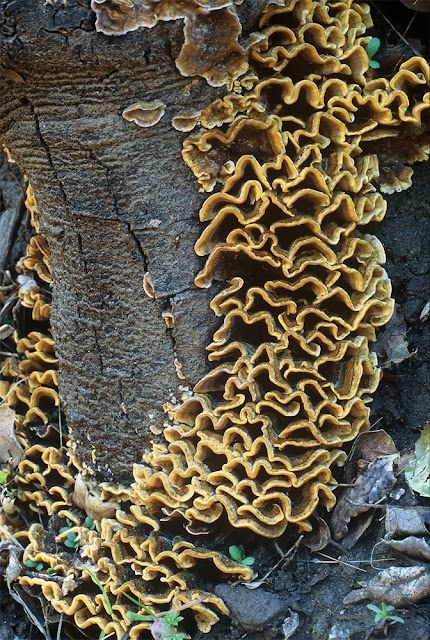
Unidentified shelf fungus, Engineers Road.


Sunday, November 24, 2013

Fall in the Mountains of San Diego County

It has to be considered a good fall, if no major wildfires broke out, and we got some rain! So this is quite a good fall, as we just received another 1.3 inches or so of much-needed rain from this latest little storm. We had a pretty fall, too, in terms of fall color. We're on the tail end of that period now, though, with many of the Black Oaks looking pretty naked these days. NO SNOW YET, for those who might have wondered.

Willow leaves, in their last hurrah, at Lake Cuyamaca last weekend.

Our Toyon has spectacular berries this season. This is one of the ones growing just outside the house.

The rains have brought out some nice fungi. These were growing all around a tree stump on Palomar Mountain this past Friday.

Part of the mushroom mass shown above. Probably Armillaria mellea, the "Honey Mushroom".

The sunset last Friday, as the storms were moving out of the area. This is a view looking west from Palomar Mountain, with mountain-hugging clouds in the foreground.

Sunday, October 6, 2013

A Nearby Trip to Chariot Canyon

Chariot Canyon is just south of Banner, at the base of the Banner Grade. It really requires four-wheel-drive to negotiate it without too much stress and anxiety. I took the truck down there in mid-August and found primarily small species of insects on the just-blooming Baccharis bushes.

An assassin bug, with TINY prey! It was lurking on Baccharis, awaiting victims visiting the little flowers.

Close-up, showing the tiny little meal. Its wing is quite iridescent!

An ambush bug, another predator lurking in the flowering Baccharis. I believe that this is Phymata pacifica. It blends in beautifully with its almost "disruptive" coloration.

A view of Chariot Canyon, south of the Golden Chariot Mine. It is an idyllic spot.

End of the line for the day. Someone had put a couple of ineffectual little straps around this big oak that had fallen in the road, presumably in an attempt to move it. It took about a ten point turn to turn around in these tight quarters in the truck, but it worked out. Will have to go back later in the season to see how things have changed.

Saturday, September 21, 2013

A Re-Visit to Scissors Crossing and Vicinity, Post-Monsoonal Rains

I made a short trip to the area around Scissors Crossing in the Anza Borrego Desert today, to see what the heavy rains have yielded, about a month after they fell (the last trip was on August 30th). The most dramatic change since the last visit was a massive explosion of White-lined Sphinx Moth larvae, and many yellow composites blooming on the desert floor. There were not many beetles to be found, with the exception of quite a few Lytta vulnerata, a large, colorful blister beetle, and a new species for me.

The old corral area, a little west of Shelter Valley. The reddish plants on the ground were heavily nibbled by the caterpillars. Ravens and crows were busily eating the caterpillars.

The find-of-the-day: Lytta vulnerata. A "life-beetle" for me!

"Rabbit Brush," upon which the Lytta were found (other Lytta vulnerata were found on a different yellow composite that I have not yet identified).

A small pile of White-lined Sphinx Moth caterpillars. It was difficult not to step on them, they were so numerous. No caterpillar hunters (Calosoma or Callisthenes) seen, though.

Monday, September 2, 2013

A Diversion to the Algodones Dunes, Imperial County, California

About a week ago, some energetic thunderstorm cells dropped rain on the Algodones Dune system in Imperial County. We thought we would explore them to see what life might have been triggered into activity by the rain.

We chose to spend one night about eight miles south of Glamis, in a Palo Verde grove nestled up against the eastern edge of the dunes.

The vegetation was much less than what we observed last year in about the third week in September. There had been massive rainfall weeks before last summer, and the dune region was full of green growth, and insect and spider activity.

This year was still very rich, though, in arthropods, and vertebrates, as well.

Around dusk, a sandstorm was visible to the west. A warning went out for the Glamis area. Several thunderstorms were visible, here and there close by, but not overhead! The wind picked up and the sand started whipping, but in about an hour, everything calmed and the rest of the night was hot, calm and dark - perfect for observing insects and other creatures!

Sunset from the dunes. Eight miles S. of Glamis, August 31, 2013.

The habitat. This photo was taken in September of 2011, a dry year.

Bolbocerastes imperialis, male. Eight miles S. of Glamis, August 31, 2013.

Edrotes arens, a small tenebrionid species that I have searched for without success in the past. They were pretty abundant on the sand of the dunes after dark. Apparently, they mimic rabbit droppings, a nice adaptation in a food-poor environment! Eight miles S. of Glamis, August 31, 2013.

Temnoscheila sp. These beetles are real biters when picked up! Quite a few came to our lights throughout the night. Eight miles S. of Glamis, August 31, 2013.

Osmidus guttatus. Eight miles S. of Glamis, August 31, 2013.

A very small tenebrionid. Probably Triorophus sp. Eight miles S. of Glamis, August 31, 2013.

Cerenopus concolor. I've seen them regularly in the local deserts over the years. Eight miles S. of Glamis, August 31, 2013.

A very large solifuge. Its body length is about 30 mm. 

These scorpions were VERY abundant on the sand of the dunes after dark. They seemed to be scattered about 3 feet apart...everywhere. 

A Sidewinder. I found this snake by almost stepping on it as I started to stand up from kneeling in the sand. Looking down, I saw the snake only a couple inches from my leg. I staggered left and it moved to the right, and all was well! Then a photo session ensued, of course. Eight miles S. of Glamis, August 31, 2013.

Sidewinder, on the move. Eight miles S. of Glamis, August 31, 2013.

Close-up of the Sidewinder. Eight miles S. of Glamis, August 31, 2013.

Western Banded Gecko. This little lizard was oozing with personality. It would take a couple steps in the sand, lash its tail like a tiny cat, and stare intelligently ahead, in search of gecko-prey. Then it would stalk an inch or two forward and repeat the process. Eight miles S. of Glamis, August 31, 2013. 

Western Banded Gecko, portrait. Eight miles S. of Glamis, August 31, 2013.

Palo Verde seedlings. These were scattered widely, triggered by the rain.
Here are a couple photos from last September, showing the vegetative growth. The vines were still present this year, but were utterly dry and desiccated, although some showed new green growth from last week's rain. The yellow composites in the photo below were not out yet this year.

Vine growth, September 2012. Eight miles S. of Glamis.

Yellow composites, September 2012. About six miles S. of Glamis.