Showing posts with label california. Show all posts

Sunday, June 9, 2019

A Live Badger Observed in Pine Hills (San Diego County)

No photos, unfortunately, but this was my first "good" view of a live badger ever, and especially interesting, at least for me, as it was in San Diego County.

On the night of May 1, 2019 while driving home from Palomar College, at around 11 pm in Pine Hills near the town of Julian I saw what looked like a low-slung cat waddle off to the left side of the road and then disappear into a small grassy ditch along the side of the road.

I decided to carefully back up and look more closely (from the car) and saw an unmistakeable badger face observing me from a foot or so from the edge of the road. That explained the short-legged waddle. I tried to take a record image with my cell phone but the head disappeared. Upon later investigation, there is a culvert in that spot which extends under the road, although on the opposite side it seems to be closed off.

I have driven along this stretch of road late at night two days per week for about 32 weeks per year over the past 12 years or so, so this sort of observation is a rarity.

For the record, the spot where this badger was seen was very close to:
33.048016, -116.636228 just south of the corner of Eagle Peak Road and Boulder Creek Road (as shown on Google maps).


Sunday, December 27, 2015

Some Fungi from "Down the Hill" (Ramona), Following our Rains

We have been getting some decent rain lately, maybe even the beginnings of the "El Nino".

Last Monday I made a little trip down to Dos Picos County Park (now called Dos Picos Regional Park) in Ramona, about 45 minutes west of Julian and our home in the Cuyamaca Mountains.

There were not a lot of "big" mushrooms, but still some nice photogenic fungi:

Probably Psathyrella conopilus (with a little unidentified friend).

These little mushrooms were growing on a small branch in the chaparral. They were about 10 mm tall.

A tiny shelf-like fungus, about 15 mm wide.

More tiny ones. The largest is about 15 mm wide.

The lichen was growing luxuriously all over branches in the chaparral, enjoying the recent rain.

An owl pellet, soaked by rain, with a good-sized skull in it.

Saturday, October 17, 2015

More Pepsis (and Others) at the Baccharis

The Baccharis sarothroides that we planted nine years ago (and which normally lives at slightly lower elevations) continues to flower...and flower, and flower. The rains seem to have created the ideal flowering conditions for them, as I don't remember them being quite this rich in prior years (although they flower every fall).

Pepsis mildei and Pepsis thisbe (and possibly P. pallidolimbata, but hard to tell due to wing wear) and the most abundant visitors, with P. mildei (with the orange antennae) being the most numerous.

I saw no Pepsis mildei over the summer at the milkweed. Those Pepsis seemed to be P. thisbe primarily.

The luxuriously flowering Baccharus. This is only a small fraction of it. 

Pepsis mildei male. He has 11 flagellomeres (long segments) on his antennae (females have 10). 

Orange antennae and dark margins on the wings identify this species (at least in this region).

I believe that this is a Pepsis thisbe male, due to the amount of hyaline (clear) edging on the wing tips.

A large bumblebee (likely a queen). Looks like Bombus occidentalis, but I am not certain yet.

This bee slowly moved from flower to flower...


Monday, July 6, 2015

Look Up!

On June 30th, a nice almost-full moon rose over the trees to the east, with some delicate clouds dressing it up a bit.

Venus and Jupiter still hovered to the west, and I thought I'd finally take a shot of them. For fun, I also did an eight minute long exposure of the two planets, letting them streak a bit.

It was truly full the next night, but to my eyes, it looks pretty round in outline here.

Venus (the larger one) and Jupiter.

"Planet-streak"

This high ISO image of the Milky Way was not taken this year - I took it in July of 2012. I may experiment with these night sky images a bit more this summer.

Sunday, August 24, 2014

A Ringtail Seen on Boulder Creek Road

A quick notation of an observation made this past week:

On August 20, 2014 (Wednesday night), I saw a Ringtail (Bassariscus astutus) around 11 pm a few miles outside of Cuyamaca Woods, south of the Boulder Creek Fire Station.

This was the best view of this species that I have ever had, as after I first spotted it in the road in front of my car, it meandered fairly casually in front of me (as I slowed the car down and crept after it). After about a minute of clear viewing, it moved off the road and started to climb a large tree. I lost sight of it after that.

There are a fair number of large trees in this area, a small riparian area that parallels the road and boulders here and there.


Monday, May 26, 2014

A Hen Turkey Decides to Take a Break on the Patio

This hen turkey decided to settle down on the patio this morning, for some reason known only to herself. Gary spotted her and called (in subdued tones) for me to come down -- with camera -- and the cats started to converge (meowing TOO much, I must say!). I finally was able to get right up against the glass to get a decent image of her, while Bonnie crouched next to me, emitting her chattery "bird meow". She had a hankering for a turkey drumstick!! For the record, Bonnie has done this same behavior with a full grown DEER that visited the patio years ago. She wants to bite off WAY more than she can chew...

She was well aware of our presence, and stiffened visibly, or even craned her neck, when little movements occurred on our side of the glass. She had some flies buzzing around her and took a peck at them now and then. She seemed uninjured when she stood up and walked away later.
Bonnie, ready to take on "big game". Bonnie never leaves the house, and would have no clue of how to hunt, I suspect...but don't tell HER that.

FOS (First of Season) Insects at the Black Light!

As the work responsibilities wane, and the weather FINALLY starts to mellow, I had a chance to put the black light out on the patio last night, in wonderfully warm, calm air. It seems like this season so far has either been cool (too cool at night here in the mountains for many insects) or very hot (with intense wind and wildfires thrown in for good measure). I hope we're starting the "normal" late spring/summer season with moderate warmth...and not so much WIND!

The first Prionus californicus of the season buzzed in to the light early on. I shifted him to one of the "photo rocks" nearby for a picture.

Prionus californicus (the California Root Borer).
Not long after, the first Polyphylla decemlineata that I have seen this season showed up (noisily, and clumsily). He did not want to pose, but I managed a quick shot of him as he clambered off this bit of sandstone.

Polyphylla decemlineata, the Ten-lined June Beetle
There was an unusually high number of reddish cockroaches, most of which were not going to the light, specifically, but were lingering around in the shadows. Usually I see just a couple of these at a time, but this time there were at least a dozen. Must be a good year for them.

Cockroach. Possibly Parcoblatta or some other native roach, or possibly Turkistan Cockroaches, which are invasives.

One of the "Giant Ants" made on appearance, as well. These ants are about 15 mm long (at least). Possibly a carpenter ant.

On the prowl...

There were also the usual Brown Leatherwings (Pacificanthia consors), Serica sp. (to be determined later by those who know them better than I), and miscellaneous moths, as well as a large Olios spider feasting on a crane fly.

A pretty typical late-May evening on the patio.


Wednesday, January 8, 2014

A Diversion to the Salton Sea: Our Annual Visit

Usually, Gary and I take a trip out to the Salton Sea sometime when the year is still new and fresh. The air is not exactly fresh at the Sea, but the birds are pretty wonderful. This year was no exception.

Snow Geese in flight, Vendel Road. There were some Ross' Geese here and there in amongst the bigger Snows.

We only saw one Burrowing Owl this year, this one along Lack Road. Interesting to see its burrow (at lower right).

We encountered this scene along Vendel Road. This was the Wildlife Refuge, and clearly marked, so it's unfortunate that there was a need to post a sign saying "Don't gas the owls"!

I loved this assemblage of Cattle Egrets at Unit One. They definitely like to maintain a certain spacing between themselves! Many Snow Geese in the background.

Sandhill Cranes flying over Vendel Road.

Sandhill Cranes in a field along Vendel Road at last light. A tiny flock of the ubiquitous Snow Geese in the background.

A mass of clouds moved in during the afternoon, creating some moody lighting on these Snow Geese along Vendel Road.

Definitely one of the "usual suspects" anywhere in SoCal at this time of year - a White-crowned Sparrow.

This was one of many White-faced Ibis seen. In the non-breeding season, they lose the whitish facial markings near the base of the bill. This was shot with my Canon Rebel THROUGH the old spotting scope, handheld, as an impromptu experiment. Then  I Photoshopped the heck out it to get the painterly feel!

Sunday, December 1, 2013

Mushroom Season

I have been writing articles for the Cuyamaca Woods POA Newsletter for several years now, and thought I'd publish some of them here, so they can have a wider audience. This one was the latest article - appropriate for the season.

Mushroom Season in Cuyamaca Woods

Now that we've had our first significant rain of the season, there might be some interesting fungi popping up here and there in the Woods.

Even though our precipitation later in the season will often be in the form of snow, when the snow melts after the storms move on, the moisture often translates into mushroom and other fungal fruiting bodies in the landscape.

I have been interested in mushrooms and fungi for many years, not because I have any interest in consuming them, but because they make fascinating photographic subjects. And they don't move, or try to run away -- always a plus when it comes to nature photography! And by the way, even if you do enjoy a little chopped mushroom in your salad or accompanying certain main dishes, it is highly advised that you do not collect wild local mushrooms for this purpose, unless you have a deep understanding of the classification and properties of wild mushrooms. As the saying goes: "There are old mushroom hunters, and there are bold mushroom hunters -- but there are no old, bold mushroom hunters!"

A little background biology might help explain the strange, ephemeral nature of mushrooms. When you see a mushroom on a log or popping out of the ground, it is just a temporary reproductive structure (or "fruiting body"), created by the more permanent mycelium of the fungus. A mycelium is a mass of string-like strands of cells (hyphae) which feed by releasing digestive enzymes into the surroundings and then absorbing the nutrients formed by the digestion. When it gets wet, this is a good time for the stationary mycelium to create a structure that can release mobile spores into the surroundings. The spores may blow away, and if they land in a favorable (usually damp) spot, grow into a new mycelium (and a new individual). That is why mushrooms only last a few days, and then seem to melt into a gooey mess when spore production is done.

One of the more spectacular local fungi is the Western Giant Puffball (Calvatia booniana), which appears almost every year on my property. It can reach a diameter of 8 -10 inches and reputedly is good to eat when young and tender (but I don't recommend it!).

Western Giant Puffball, Calvatia booniana

Another large, eye-catching local fungus is the Jack-O-Lantern (Omphalotus olivascens) an orange-tan mushroom that reputedly can be bioluminescent. I have attempted to observe this bioluminescence after dark but have never seen it firsthand.

Jack-O-Lantern, Mountain Meadow Road

Another common local fungus is the Turkey Tail (Trametes versicolor), a shelf fungus. After rain, the Turkey Tails growing here and there, typically on dead wood, will seem to come to life, showing colors and texture not seen when they are dry and desiccated.
Turkey Tail, Sandy Creek Road

I have encountered quite a few other photogenic fungi up here in the Woods in the years that we have lived here, and although the lower foothill areas are usually much richer in colorful or attractive mushrooms in winter, we're still not too bad, if you take the time to look.

Coprinus sp., Mountain Meadow Road

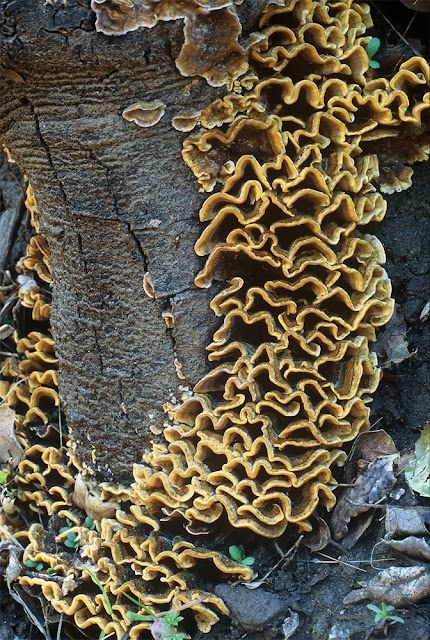
Unidentified shelf fungus, Engineers Road.


Sunday, June 9, 2013

A Diversion to the Southern Sierra Nevada Mountains: "Scorpion-ville"!

From June 3 through June 6, we spent time camping at Kennedy Meadows in Tulare County. This is an area dominated by sage and other desert-loving shrubs, and Pinyon Pines. The Kern River winds its way through the area.

Where we camped, there were extensive areas of "sand" (really finely grained decomposed granite, or DG), and I noticed many, many small holes in the sand, with a small pile of debris outside of them. After dark, a small creature could be seen at the entrance of some of the burrows, but it would withdraw out of sight when light fell on it, so the creatures and their burrows remained mysteries for a short while. Then, I was able to take a photo from some distance away, and zoom in on the creature in the entryway. It became obvious that it was a scorpion! Also, scorpions were out and about after dark in the sandy areas, especially near my black light which was attracting nice scorpion-prey.

Over a couple days I got quite a few photographs of the scorpions, in and out of their burrows.

This was the first scorpion I saw out of its burrow, near my black light. It is the California Common Scorpion, Paruroctonus silvestrii. Thanks to Kari McWest for this determination.
The same individual as above, with a small moth in range!
The typical resting position in the entryway of a burrow. This is the Swollenstinger Scorpion, Anuroctonus phaiodactylus. Thanks to Kari McWest for this determination.
Another Swollenstinger Scorpion in its burrow.
Three burrows in close proximity on a small embankment. There were easily dozens of burrows near our campsite and surely hundreds (if not thousands) in the region. There were burrows ranging from about an inch in width, to much smaller (perhaps 1/4 of an inch).
The second scorpion I saw out of its burrow. Another Swollenstinger Scorpion. These seemed by far the most common (actually I only observed one California Common Scorpion - despite its name - the one shown above!) This scorpion was sensitive and assumed a threat posture when I leaned in too close for a photo. In my experience, most scorpions do NOT get this agitated in this sort of photography situation.
The scorpion above, in threat-posture.
The same individual as above, at a different angle.
Another Swollenstinger Scorpion seen later, near the edge of the thicker woods. This one did not get agitated when I took this photo.


Saturday, April 20, 2013

Deer Bot Flies at Lake Morena

After reading Margarethe Brummermann's blog post yesterday about bot flies, I became intrigued by the fuzzy, bumblebee-mimic deer bot fly pictured in the post:

Then I consulted Lynn Monroe's new book: "Desert Insects and Kin of Southern California: A Photographic Survey and Natural History - Anza Borrego Desert State Park" and became convinced that these bot flies might not only exist in the region, but that they might be out and about at this time of year.

So after meeting Gary's son Ted at the Mexican border to see him off on his Pacific Crest Trail adventure, Gary and I decided to take a hike at Lake Morena, convenient and close by. I did not really expect perfect "hill top" conditions (hill-topping is the habit of some insects of congregating at a high point like the top of a hill or mountain and often establishing territories, in an attempt to intercept passing potential mates). Bot flies are known for this behavior, and amazingly, after a false alarm, in which I thought a smaller carpenter bee was a bot fly (!), we actually FOUND deer bot flies perched and periodically flying about at a high point in the chaparral overlooking the lake!


Cephenemyia jellisoni, a Deer Bot Fly. This specimen was captured at Lake Morena, southern San Diego County, on April 20, 2013. 

Dorsal view of Cephenemyia jellisoni, deer bot fly. Lake Morena, April 20, 2013.
These flies do not feed as adults, but after mating, females will deposit tiny larvae in the nasal cavities of Mule Deer. The maggots can reach as much as an inch in length, and will develop inside the respiratory passages of the deer.  Later the maggots will be sneezed out, to eventually pupate in the ground and emerge as an adult fly. Apparently this does little harm to the deer, despite its repulsiveness to humans.

The "hill top" at Lake Morena. Rich chaparral habitat. 
Lake Morena, San Diego County, California.