Friday, June 21, 2013

A Very Orange-backed San Diego Alligator Lizard

On a walk a few days ago, we discovered an alligator lizard relaxing in the shade near Engineers Road. Due to its geographical location, it would have to be the subspecies of the Southern Alligator Lizard, Elgaria multicarinata webbii (the San Diego Alligator Lizard).

I have never seen one with such brilliant orange on its back as this individual! But after doing a bit of searching on-line, the orange-backed types are not too rare, apparently. Just a genetic variant, although I wonder if it could be environmental (something to do with diet)?

Alligator lizards are masters of the "Intense Stare"!

ALMOST a full view of the orange-backed individual.

For comparison with the lizard above, here is one with a "normal" back coloration (and a MASSIVE appetite!) from near our patio in August of 2010.

Another alligator lizard from our property, which apparently had a dramatic encounter with a predator, from April 2010.

Sunday, June 9, 2013

A Diversion to the Southern Sierra Nevada Mountains: "Scorpion-ville"!

From June 3 through June 6, we spent time camping at Kennedy Meadows in Tulare County. This is an area dominated by sage and other desert-loving shrubs, and Pinyon Pines. The Kern River winds its way through the area.

Where we camped, there were extensive areas of "sand" (really finely grained decomposed granite, or DG), and I noticed many, many small holes in the sand, with a small pile of debris outside of them. After dark, a small creature could be seen at the entrance of some of the burrows, but it would withdraw out of sight when light fell on it, so the creatures and their burrows remained mysteries for a short while. Then, I was able to take a photo from some distance away, and zoom in on the creature in the entryway. It became obvious that it was a scorpion! Also, scorpions were out and about after dark in the sandy areas, especially near my black light which was attracting nice scorpion-prey.

Over a couple days I got quite a few photographs of the scorpions, in and out of their burrows.

This was the first scorpion I saw out of its burrow, near my black light. It is the California Common Scorpion, Paruroctonus silvestrii. Thanks to Kari McWest for this determination.
The same individual as above, with a small moth in range!
The typical resting position in the entryway of a burrow. This is the Swollenstinger Scorpion, Anuroctonus phaiodactylus. Thanks to Kari McWest for this determination.
Another Swollenstinger Scorpion in its burrow.
Three burrows in close proximity on a small embankment. There were easily dozens of burrows near our campsite and surely hundreds (if not thousands) in the region. There were burrows ranging from about an inch in width, to much smaller (perhaps 1/4 of an inch).
The second scorpion I saw out of its burrow. Another Swollenstinger Scorpion. These seemed by far the most common (actually I only observed one California Common Scorpion - despite its name - the one shown above!) This scorpion was sensitive and assumed a threat posture when I leaned in too close for a photo. In my experience, most scorpions do NOT get this agitated in this sort of photography situation.
The scorpion above, in threat-posture.
The same individual as above, at a different angle.
Another Swollenstinger Scorpion seen later, near the edge of the thicker woods. This one did not get agitated when I took this photo.


Friday, May 31, 2013

The Dreaded Poodle Dog Bush!

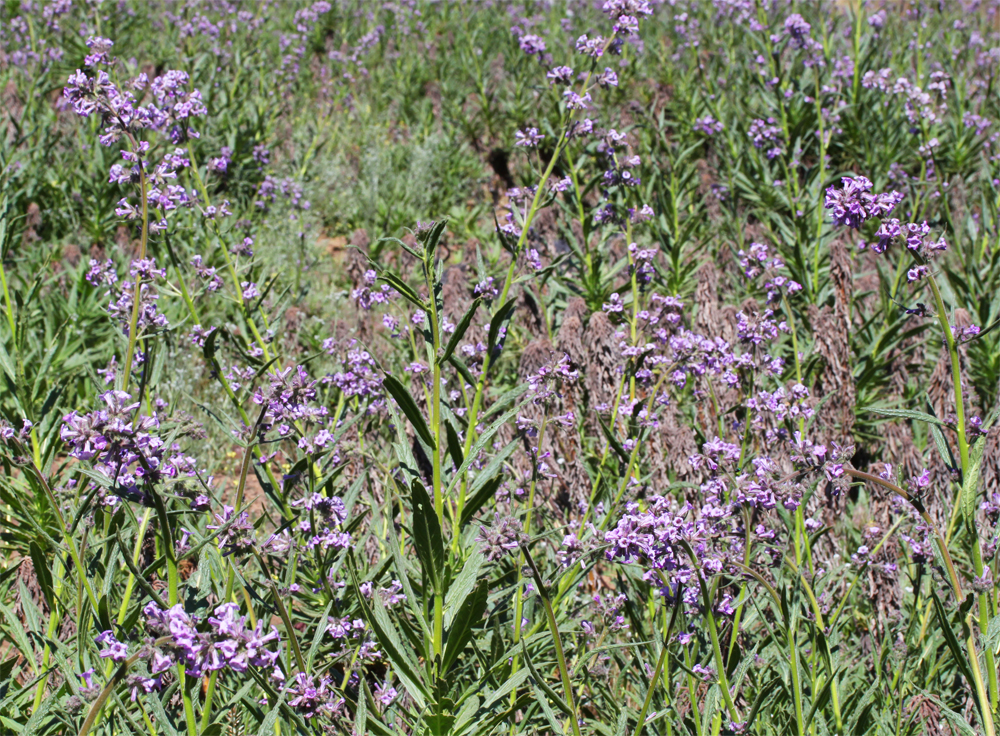
In parts of nearby Cuyamaca Rancho State park, there are massive stands of tall, impressive plants with towering spikes of pink-to-purple flowers. These plants seem very inviting to visit, especially to a bug-lover like myself, as the nectar draws in a multitude of wasps and bees.

"Don't pet ME!"

But this is no benign plant -- it is the dreaded Poodle Dog Bush (Eriodictyon parryi), a plant that I have seen before on occasion in the Cuyamaca Mountains following the Cedar Fire (even on our own property), but that never lasted more than a season (at least to my eyes). It is dreaded as the entire plant -- stems, leaves and flowers -- is covered in fine hairs, and these hairs when touched by human skin, penetrate and deliver a chemical that brings on symptoms something akin to a combination of poison oak and stinging nettle combined. Being sensitive to both of these other plants, I can sympathize with the misery this would translate to! Intensely itchy blisters that last for days, with some pain as well. Apparently even smelling it can lead to a negative allergic reaction.

The lovely flower spike.

This species is a fire-follower, requiring intense heat for germination of its seeds, and after some controlled burning across from the Paso Picacho Campground in the state park, several big stands of the plant have sprung up. I decided to pay the $8 day use fee this afternoon in order to walk over and photograph the plants.

Unfortunately, possibly too late, I realized as I walked towards the stands, that there were some small, few-inches-high Poodle Dog Bushes along the way, and I may have stepped on them. After getting home, I washed and scrubbed my shoes and carefully stripped off my jeans and socks, in the same way I would do if I had contacted poison oak. Hopefully I escaped unscathed -- it's a delayed reaction, so I guess I'll find out in a couple days.

I also read (after the fact) that breathing the "perfume" can cause a negative reaction. In my photographing the plants, the smell was unmistakable and rather pungent. Again, time will tell if I pay a price for these photos, I guess.

My step-son, Ted is currently hiking the Pacific Crest Trail, and encountered some Poodle Dog Bush in the past few days, and reports that the skin reaction is maddeningly itchy and re-contamination occurs readily from a contaminated sleeping bag! This plant wants to create a huge seed set and not get eaten too much by herbivores while attracting its pollinators. It has an interesting way of achieving this, to be sure.

The tiny hairs are visible here.

The flower spikes are several feet high.

All photos taken in Cuyamaca Rancho State Park, across from the Paso Picacho Campground. 


Thursday, May 30, 2013

The Wild Turkey Family

A little over a week ago, I heard a lot of bird vocalizations outside the house, including much crow cawing and some classic upset-turkey sounds.

I suspected the bobcat of being in the area, and wandered over towards the neighboring property where the crow hullaballoo was coming from, but saw no sign of the cat.

All the while, a female turkey was standing stationary just above the driveway, clucking continuously.

As I made my way back towards the house, I heard tiny peeping sounds from the direction that I had come. The crows at this point had dispersed. Then the female turkey switched to highly agitated gobbling, and I knew then that it was a mother turkey who had become separated from her young.

I went right inside, but "spied" from the upstairs bedroom window, and within about a minute saw a group if quite tiny baby turkeys rejoining their mother. Then the mother moved off, with the babies following (and sometimes leading). That's where the photo below came from.

Mom turkey with eight youngsters. Reunited!
It's been about a week-and-a-half and we have seen this mother with her young almost very day on or near our property. Yesterday there was tell-tale evidence of splashing at the ground-level bird bath on the patio.

Today I saw the mother again, in almost the exact spot that the photo above shows, and I could see the group (and there were still eight babies visible this time) moving towards the patio where the bird bath is.

I tried to spy without being seen, but that was difficult, and I didn't want to risk scaring them. But I caught a glimpse of the group fully engaged in drinking at the bath! I managed one photo, with a chair and border of the glass window clearly visible in the shot.

Cool drink time for the turkey family.
So far this mother has been quite successful at protecting her brood!

Sunday, April 28, 2013

Bobcat Turkey Kill: The Aftermath

The day after we saw the resident Bobcat kill a Wild Turkey, we looked around for signs of the turkey carcass.

Before systematically searching, Gary decided to water the two baby Incense Cedar trees that we recently planted on the property. After watering the first one, he noticed that the little berm around the second one was disturbed and the dirt pushed over to one side of the tree. A little prodding revealed...a fresh turkey leg!

Turkey leg unearthed from its cache.

Bobcats are known to cache excess food for future consumption, so this seems likely to be a snack stored for later.

Then we walked over to the area that we saw the cat with the turkey. There was a mass of feathers at what must have been the initial attack site. We did not witness that event the other evening.


Turkey feathers of all kinds.

Then we checked out the spots where we saw the bobcat with the turkey in its mouth, and saw more feathers.


At one point we saw the cat spit a bunch of smaller feathers out, in the spot shown above.

Then we followed the trail of feathers to the edge of a thick area of vegetation which would be almost impossible to penetrate (for a human), so we gave up.

The leg was several hundred yards downslope from these feather areas, so the cat was busy during the night (if it indeed was responsible for caching it).


Friday, April 26, 2013

The Bobcat Vanquishes a TURKEY!

This evening in the last moments of daylight, we were sitting out on our patio, and heard a swishing of leaves on the neighboring property. Looking that way, we saw one of the resident bobcats with a wild turkey in its grip. The turkey was alive and thrashing around a bit; thus the noise. The bobcat proceeded to drag the turkey a short distance away, and at times paused to look at US with feathers in its mouth. Eventually it dragged the turkey upslope out of sight.

Within minutes, many crows gathered and made a massive ruckus of cawing -- typical behavior around the bobcat, as in the past the bobcat's movements through the landscape was trackable by following the noise of the jays and other birds.

Tomorrow we'll look around to see if the turkey carcass is still in the area.


Saturday, April 20, 2013

Deer Bot Flies at Lake Morena

After reading Margarethe Brummermann's blog post yesterday about bot flies, I became intrigued by the fuzzy, bumblebee-mimic deer bot fly pictured in the post:

Then I consulted Lynn Monroe's new book: "Desert Insects and Kin of Southern California: A Photographic Survey and Natural History - Anza Borrego Desert State Park" and became convinced that these bot flies might not only exist in the region, but that they might be out and about at this time of year.

So after meeting Gary's son Ted at the Mexican border to see him off on his Pacific Crest Trail adventure, Gary and I decided to take a hike at Lake Morena, convenient and close by. I did not really expect perfect "hill top" conditions (hill-topping is the habit of some insects of congregating at a high point like the top of a hill or mountain and often establishing territories, in an attempt to intercept passing potential mates). Bot flies are known for this behavior, and amazingly, after a false alarm, in which I thought a smaller carpenter bee was a bot fly (!), we actually FOUND deer bot flies perched and periodically flying about at a high point in the chaparral overlooking the lake!


Cephenemyia jellisoni, a Deer Bot Fly. This specimen was captured at Lake Morena, southern San Diego County, on April 20, 2013. 

Dorsal view of Cephenemyia jellisoni, deer bot fly. Lake Morena, April 20, 2013.
These flies do not feed as adults, but after mating, females will deposit tiny larvae in the nasal cavities of Mule Deer. The maggots can reach as much as an inch in length, and will develop inside the respiratory passages of the deer.  Later the maggots will be sneezed out, to eventually pupate in the ground and emerge as an adult fly. Apparently this does little harm to the deer, despite its repulsiveness to humans.

The "hill top" at Lake Morena. Rich chaparral habitat. 
Lake Morena, San Diego County, California.