Showing posts with label utah. Show all posts

Sunday, September 6, 2015

A Diversion to Southern Utah, Part 1: Reptiles (of Primarily the Lizard-Sort)

Gary and I took our semi-regular trip to southern Utah this July (later than usual, with hopes that some monsoonal rain might have brought out new and different things than we have seen in June in the past).

The monsoons had delivered a couple weeks previously, and the vegetation was quite lush and green in most of the places we visited. And insect and other animal life was pretty abundant. We drove to the Ponderosa Grove Campground just north of Coral Pink Sand Dunes State Park (in Kane County) for the first night, then spent two nights on the west end of Long Canyon in the Grand Staircase Escalante NM next (the same spot we stayed in two years earlier), then spent the last three nights at Canyonlands National Park, at the Squaw Flat Campground (something new for us).

This installment will cover some of the scaly ones we saw. Many of the lizards in this region of the southwest are a bit different from the common ones we see in southern California, although there is certainly some overlap of species.

Sceloperus graciosus, the Common Sagebrush Lizard. They DID seem pretty common - definitely the species we saw most frequently on the trip. This one was at the Ponderosa Grove Campground. It posed for its picture very cooperatively (as did most of the others we encountered on the trip). 
Another S. graciosus. This one was the most beautifully-colored one we saw. It was also at the Ponderosa Grove Campground.
The "lizard of the trip" (I would say). Gambelia wizlizenii (the Long-nosed Leopard Lizard). We saw two of these spectacular creatures, both on walks at Canyonlands, near the Squaw Flat Campground. Gary spotted both of them.
Another sagebrush lizard, blending fairly well with the never-ending Utah red-rock landscape. Canyonlands NP.
A pair of side-blotched lizards on a rock on our walk back to camp at Canyonlands (on the first morning).
I'm guessing these are Plateau Side-blotched Lizards (Uta stansburiana uniformis). This was one of the pair shown above.
The other member of the pair shown above. Slightly different markings.
A slender-looking side-blotched - showing off the blotch! Only after looking at the photo later did I see all the missing digits on the right forefoot.
Western Whiptail, Aspidoscelis tigris. This bold lizard was rummaging around in the Datura which was abundant in our campsite. We watched it as it found a prey item of some sort and then saw that it was a nice sphingid caterpillar (something I would have liked photographing!).  The lizard kept partially-swallowing the caterpillar, crunching down on it over and over, and eventually it went down the hatch. This was the only photo I got that had some decent resolution, but this episode reminded me of the alligator lizard that ate the HUGE sphinx moth caterpillar on our Datura at home a few years back. 
Our caterpillar-eater. Luckily the cat is mostly water...
This snake zoomed past when we were exploring the ephemeral pools with shrimp in them at Canyonlands. My best guess is Coluber taeniatus, the Striped Whipsnake.
Lesser Earless Lizard, Holbrookia maculata, probably H. maculata campi, the Plateau Earless Lizard. This hot little guy was not in Utah, actually. It was seen in a sagebrush area north of Flagstaff, Arizona about two weeks later (on my Arizona trip).


Thursday, July 18, 2013

A Diversion to Southern Utah: Mammals and Reptiles

The deserts of southern Utah are a treasure trove of herps, and some of the lizards cooperated for photographs. In the pine forests, many squirrels were to be seen, including Douglas' Squirrel (not photographed), the ubiquitous Golden-mantled Ground Squirrels, and probably two species of chipmunk.

A Golden-mantled Ground Squirrel, looking very much like a large chipmunk. Several of these squirrels invaded our campsite every day, and tried their darndest to filch food. Posey Lake, Utah.

Another Golden-mantled, posing in the morning light. Posey Lake, Utah.

Aren't I just too cute? Posey Lake, Utah.

This one liked sitting next to the pot scrubber, but never offered to help clean up. Posey Lake, Utah.

Without a long lens, the diminutive chipmunks were difficult to photograph, even though they practically climbed in our laps in our camp site trying to get food (which we never gave them). One actually did jump onto Gary, and was immediately shown the way to the ground! I am guessing that this one is a Colorado Chipmunk, and I think the bold one that climbed on Gary was a Least Chipmunk. Posey Lake, Utah.

I think that this is a Sagebrush Lizard, Sceloporus graciosus. It was practically a greeter at the Grand Staircase Escalante Visitor's Center, very fearless and seeming almost pleased to pose for photos. Escalante, Utah.

Another view of the same lizard above. Escalante, Utah.

After doing a bit of research, I think this lizard is a Tree Lizard, Urosaurus ornatus. Multiple sources described it as often matching it's background, and this one is doing a good job on the red rock, here. Coyote Gulch, off Hole-in-the-Rock Road, Grand Staircase Escalante, Utah.

The biggest lizards, with personalities to match, that we saw, were these Desert Spiny Lizards, Sceloporus magister. Coyote Gulch, off Hole-in-the-Rock Road, Grand Staircase Escalante, Utah.

Here is a Desert Spiny with an orange head (the Orange-headed Desert Spiny Lizard). Coyote Gulch, off Hole-in-the-Rock Road, Grand Staircase Escalante, Utah.

These lizards liked to pose, and who wouldn't with looks like this? Coyote Gulch, off Hole-in-the-Rock Road, Grand Staircase Escalante, Utah.

Tuesday, July 16, 2013

A Diversion to Southern Utah: The Beetles

We made a trip to southern Utah from July 7 through July 14, camping and exploring. The monsoon rains had begun to fall, but were not too disruptive of our activities, luckily. But they had brought out quite a lot of life, including quite a few beetle species, many of which were real surprises to me. Here is a selection of some of the beetles we saw...

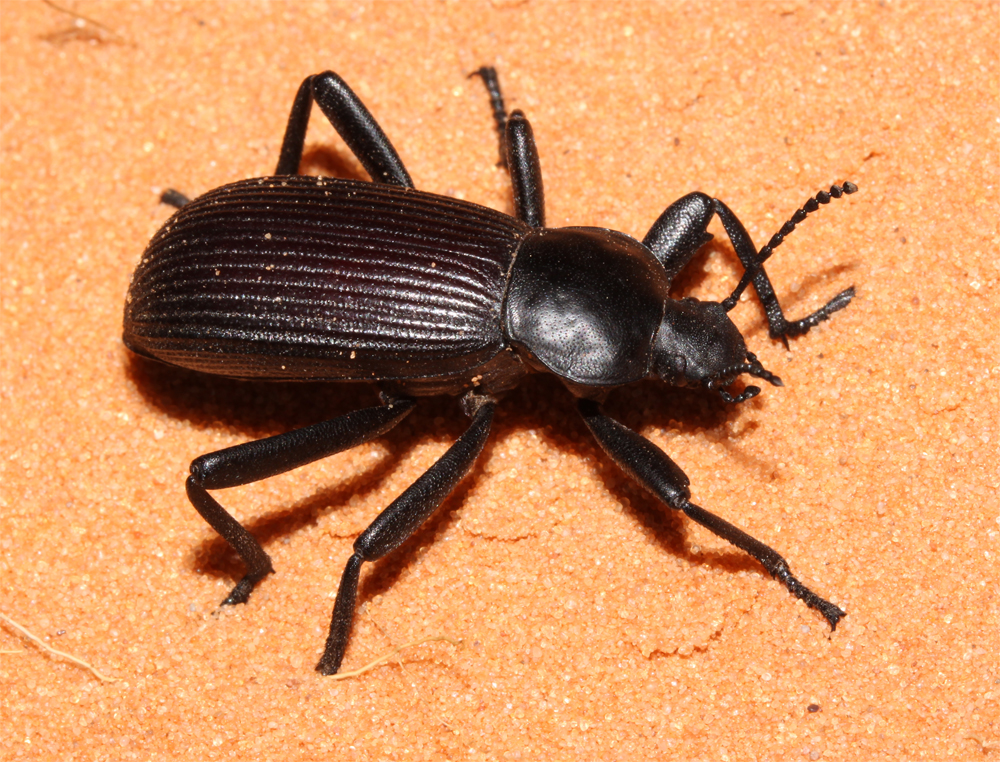
Eleodes caudiferus, a real southern Utah phenomenon! These were rushing around on the dunes at Moquith Mountain Wilderness Study Area, a BLM parcel north of Coral Pink Sand Dunes State Park. Some thunderstorms created shade in the late afternoon here, and that coolness seemed to bring out the tenebrionids.
Likely Craniotus sp. The most abundant beetle on the sand at Moquith Mt. WSA.
Eleodes obscurus, a common darkling beetle of Arizona and Utah. Moquith Mt. WSA
Hister beetles in a mating frenzy! Moquith Mt. WSA.
Many Polyphylla came to black lights at Moquith Mountain WSA and the adjacent Ponderosa Grove Campground. 
Lucanus mazama at Moquith Mt. WSA. This surprised me, but I was soon to learn that this is a very common beetle near cottonwoods in S. Utah. This one is a male, with fairly large mandibles.
Moneilema sp. This beetle scurried past one afternoon at our next destination, Long Canyon in Grand Staircase Escalante.
Another Lucanus mazama, this time at Long Canyon. A female, with smaller mandibles. Several were seen at this location. On our last day in Utah, I saw eight L. mazama specimens at the grocery store in Escalante, dead or dying, apparently attracted to the store's lights.
Lichnanthe rathvoni in a Cottonwood-dominated riparian area. Det. Dr. A. Evans.
A dorsal view of the Lichnanthe rathvoni above.
Brown Polyphylla. This one was at the slot canyon in Long Canyon, a magical spot, with a massive old-growth cottonwood growing at its entrance and a clean beautiful, narrow slot with wonderful tall walls extending into the mountainside. 
Ellipsoptera marutha, a VERY common tiger beetle in Long Canyon. 
Out last destination on this trip was the high elevation forest north of the town of Escalante. We camped at Posey Lake, in the Box-Death Hollow Wilderness. The story of the "Box" and the "Death" is a complete mystery to us...! This is Odonteus obesus, which came to a black light set up by the lake.
Probably Phaenops drummondi, a small buprestid. It was found on a hike near Posey Lake.
These black elaterids were somewhat common flying in the daytime in the forest. Posey Lake.
Diplotaxis sp., the only predictable beetle coming to lights at Posey Lake. The beetle fauna was almost absent at night here.
A lepturine longhorn. These were found on lupine near Posey Lake.
Trichiotinus sp. on thistle. Near Posey Lake.