Monday, August 5, 2013

A Diversion to Southeast Arizona: The Beetles, Part I - Scarabs

I spent a week in southeast Arizona, in the vicinity of Tucson and points south, east and west from July 22 to July 29. Part of this trip involved participating in the annual Bugguide Gathering, but I arrived several days early to explore and search for insects.

Here are some of the beetles found on these days. The monsoon was in progress but seemed a bit weak. Still, many interesting beetles, other insects, and other organisms were out and about.

Chrysina beyeri, a very common beetle in Madera Canyon, Santa Rita Mountain Range. It is nocturnal and readily comes to lights.
This "pile" of mating Chrysina beyeri were sitting on a sheet under a black light. They were locked in this arrangement for at least a half hour, and make an interesting "art" photograph! Madera Canyon.
Chrysina gloriosa, the Glorious Beetle. What appear as blackish stripes are shiny silver. A truly gloriously beautiful beetle! Madera Canyon.
Strategus aloeus, an Ox Beetle. This is a large male. This species is common in Madera Canyon, also, and occurs from the mesquite scrubland all the way up through the oak woodland, in my experience.
Strategus aloeus, female. She lacks the elaborate horns of the male above. Madera Canyon.
Strategus cessus. Males and females look very similar and lack horns. Madera Canyon.
Dichotomius colonicus, a type of dung beetle. This is one of the larger dung beetle species in North America north of Mexico. There are many species in this genus in Mexico and points south, but only two found in the United States. Madera Canyon.
Canthon indigaceus, a small ball-rolling dung beetle. This one was found on the Gleeson Road, rolling balls alongside Canthon imitator, a larger species with a black coloration (see below).
Canthon imitator, in the process of forming a dung ball with cow dung. A Canthon indigaceus can be seen at the upper left.
Canthon imitator, atop its ball. A tiny dipteran sits on the ground to the right. Some of these little flies were clinging to the beetles while the beetles rolled their balls. Gleeson Road.
Canthon imitator, with dung ball. The two beetles on the right were engaged in a furious battle, presumably to determine ownership of the ball. The beetle on the left stayed stationary and did not enter the fray. Gleeson Road.
What appears to be Polyphylla hammondi, a fairly common species in the western United States. Madera Canyon.
Polyphylla hammondi. At the truck stop at the Intersection of Ruby Road and I-19. This location is adjacent to the Santa Cruz River and its lights attract many interesting insects at night during monsoon season.
Pelidnota lugubris. A common species, this one found at the well-lit rest area on the northbound side of I-19, south of Green Valley.
Cotalpa consobrina. Another common species in this area, sometimes accumulating in the thousands at the Border Patrol checkpoint lights along I-19. This one was at the Ruby Road truck stop.

Sunday, July 21, 2013

The Aftermath of the Chariot Fire in the Laguna Mountains

I took a drive along the Sunrise Highway today, to observe the damage from the Chariot Fire, which started on July 7. In general, most of the forest in the Laguna Mountain Recreation Area is still intact and unburned. The worst damage occurred on the northern edge of the forest, and in the chaparral to the east of Sunrise Highway.

Driving south on the Sunrise Highway, the first signs of the burn occur just after entering the Laguna Mountain Recreation Area. The burn was confined to the east side of the road at this point. The west side of the road was burned in the Pines Fire in 2002, so has had over ten years of recovery time.

The patchiness of the burn in the chaparral.

The beginnings of the pine forest. This is a view of the east side of Sunrise Highway, but the fire jumped the road in this area, slightly south of the previous photo's location. There was a lot of mist here from a mass of moisture that moved into the area today.

Partially burned pine.

The west side of the Sunrise Highway, north of the Al Bahr Shrine Camp.

The worst hit of the camps and retreats along this stretch. 

Al Bahr Shrine Camp. Green, unburned forest is visible in the background here.

Some of the damage at the Al Bahr Shrine Camp.

Just past the Al Bahr Shrine Camp (heading south) and across from the Foster Lodge, is the entrance to these campgrounds and hiking areas. As shown, there was no access, so I could not see how this spot fared in the fire. 

Just south of the Horse Heaven Campground, which is just south of the Laguna/El Prado Campgrounds shown in the previous photo, the fire ended, at least as far as what was visible from the Sunrise Highway.

Some typical forest south of the Horse Heaven Campground, green and alive!

Thursday, July 18, 2013

A Diversion to Southern Utah: Mammals and Reptiles

The deserts of southern Utah are a treasure trove of herps, and some of the lizards cooperated for photographs. In the pine forests, many squirrels were to be seen, including Douglas' Squirrel (not photographed), the ubiquitous Golden-mantled Ground Squirrels, and probably two species of chipmunk.

A Golden-mantled Ground Squirrel, looking very much like a large chipmunk. Several of these squirrels invaded our campsite every day, and tried their darndest to filch food. Posey Lake, Utah.

Another Golden-mantled, posing in the morning light. Posey Lake, Utah.

Aren't I just too cute? Posey Lake, Utah.

This one liked sitting next to the pot scrubber, but never offered to help clean up. Posey Lake, Utah.

Without a long lens, the diminutive chipmunks were difficult to photograph, even though they practically climbed in our laps in our camp site trying to get food (which we never gave them). One actually did jump onto Gary, and was immediately shown the way to the ground! I am guessing that this one is a Colorado Chipmunk, and I think the bold one that climbed on Gary was a Least Chipmunk. Posey Lake, Utah.

I think that this is a Sagebrush Lizard, Sceloporus graciosus. It was practically a greeter at the Grand Staircase Escalante Visitor's Center, very fearless and seeming almost pleased to pose for photos. Escalante, Utah.

Another view of the same lizard above. Escalante, Utah.

After doing a bit of research, I think this lizard is a Tree Lizard, Urosaurus ornatus. Multiple sources described it as often matching it's background, and this one is doing a good job on the red rock, here. Coyote Gulch, off Hole-in-the-Rock Road, Grand Staircase Escalante, Utah.

The biggest lizards, with personalities to match, that we saw, were these Desert Spiny Lizards, Sceloporus magister. Coyote Gulch, off Hole-in-the-Rock Road, Grand Staircase Escalante, Utah.

Here is a Desert Spiny with an orange head (the Orange-headed Desert Spiny Lizard). Coyote Gulch, off Hole-in-the-Rock Road, Grand Staircase Escalante, Utah.

These lizards liked to pose, and who wouldn't with looks like this? Coyote Gulch, off Hole-in-the-Rock Road, Grand Staircase Escalante, Utah.

Tuesday, July 16, 2013

A Diversion to Southern Utah: The Beetles

We made a trip to southern Utah from July 7 through July 14, camping and exploring. The monsoon rains had begun to fall, but were not too disruptive of our activities, luckily. But they had brought out quite a lot of life, including quite a few beetle species, many of which were real surprises to me. Here is a selection of some of the beetles we saw...

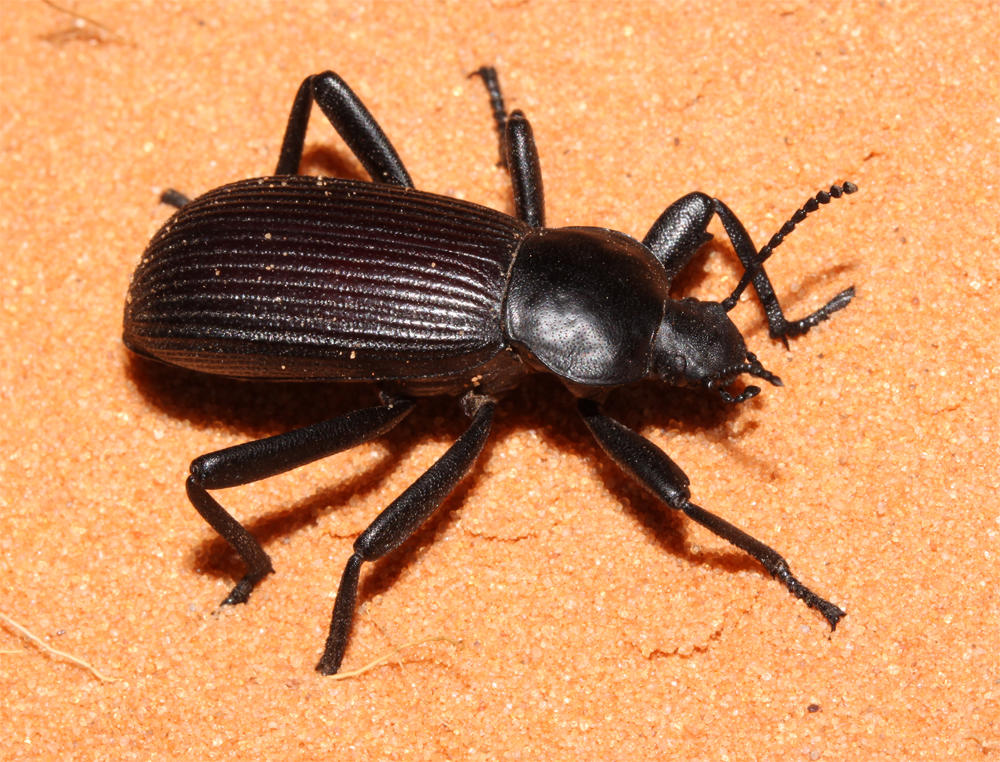
Eleodes caudiferus, a real southern Utah phenomenon! These were rushing around on the dunes at Moquith Mountain Wilderness Study Area, a BLM parcel north of Coral Pink Sand Dunes State Park. Some thunderstorms created shade in the late afternoon here, and that coolness seemed to bring out the tenebrionids.
Likely Craniotus sp. The most abundant beetle on the sand at Moquith Mt. WSA.
Eleodes obscurus, a common darkling beetle of Arizona and Utah. Moquith Mt. WSA
Hister beetles in a mating frenzy! Moquith Mt. WSA.
Many Polyphylla came to black lights at Moquith Mountain WSA and the adjacent Ponderosa Grove Campground. 
Lucanus mazama at Moquith Mt. WSA. This surprised me, but I was soon to learn that this is a very common beetle near cottonwoods in S. Utah. This one is a male, with fairly large mandibles.
Moneilema sp. This beetle scurried past one afternoon at our next destination, Long Canyon in Grand Staircase Escalante.
Another Lucanus mazama, this time at Long Canyon. A female, with smaller mandibles. Several were seen at this location. On our last day in Utah, I saw eight L. mazama specimens at the grocery store in Escalante, dead or dying, apparently attracted to the store's lights.
Lichnanthe rathvoni in a Cottonwood-dominated riparian area. Det. Dr. A. Evans.
A dorsal view of the Lichnanthe rathvoni above.
Brown Polyphylla. This one was at the slot canyon in Long Canyon, a magical spot, with a massive old-growth cottonwood growing at its entrance and a clean beautiful, narrow slot with wonderful tall walls extending into the mountainside. 
Ellipsoptera marutha, a VERY common tiger beetle in Long Canyon. 
Out last destination on this trip was the high elevation forest north of the town of Escalante. We camped at Posey Lake, in the Box-Death Hollow Wilderness. The story of the "Box" and the "Death" is a complete mystery to us...! This is Odonteus obesus, which came to a black light set up by the lake.
Probably Phaenops drummondi, a small buprestid. It was found on a hike near Posey Lake.
These black elaterids were somewhat common flying in the daytime in the forest. Posey Lake.
Diplotaxis sp., the only predictable beetle coming to lights at Posey Lake. The beetle fauna was almost absent at night here.
A lepturine longhorn. These were found on lupine near Posey Lake.
Trichiotinus sp. on thistle. Near Posey Lake.

Friday, June 21, 2013

A Very Orange-backed San Diego Alligator Lizard

On a walk a few days ago, we discovered an alligator lizard relaxing in the shade near Engineers Road. Due to its geographical location, it would have to be the subspecies of the Southern Alligator Lizard, Elgaria multicarinata webbii (the San Diego Alligator Lizard).

I have never seen one with such brilliant orange on its back as this individual! But after doing a bit of searching on-line, the orange-backed types are not too rare, apparently. Just a genetic variant, although I wonder if it could be environmental (something to do with diet)?

Alligator lizards are masters of the "Intense Stare"!

ALMOST a full view of the orange-backed individual.

For comparison with the lizard above, here is one with a "normal" back coloration (and a MASSIVE appetite!) from near our patio in August of 2010.

Another alligator lizard from our property, which apparently had a dramatic encounter with a predator, from April 2010.